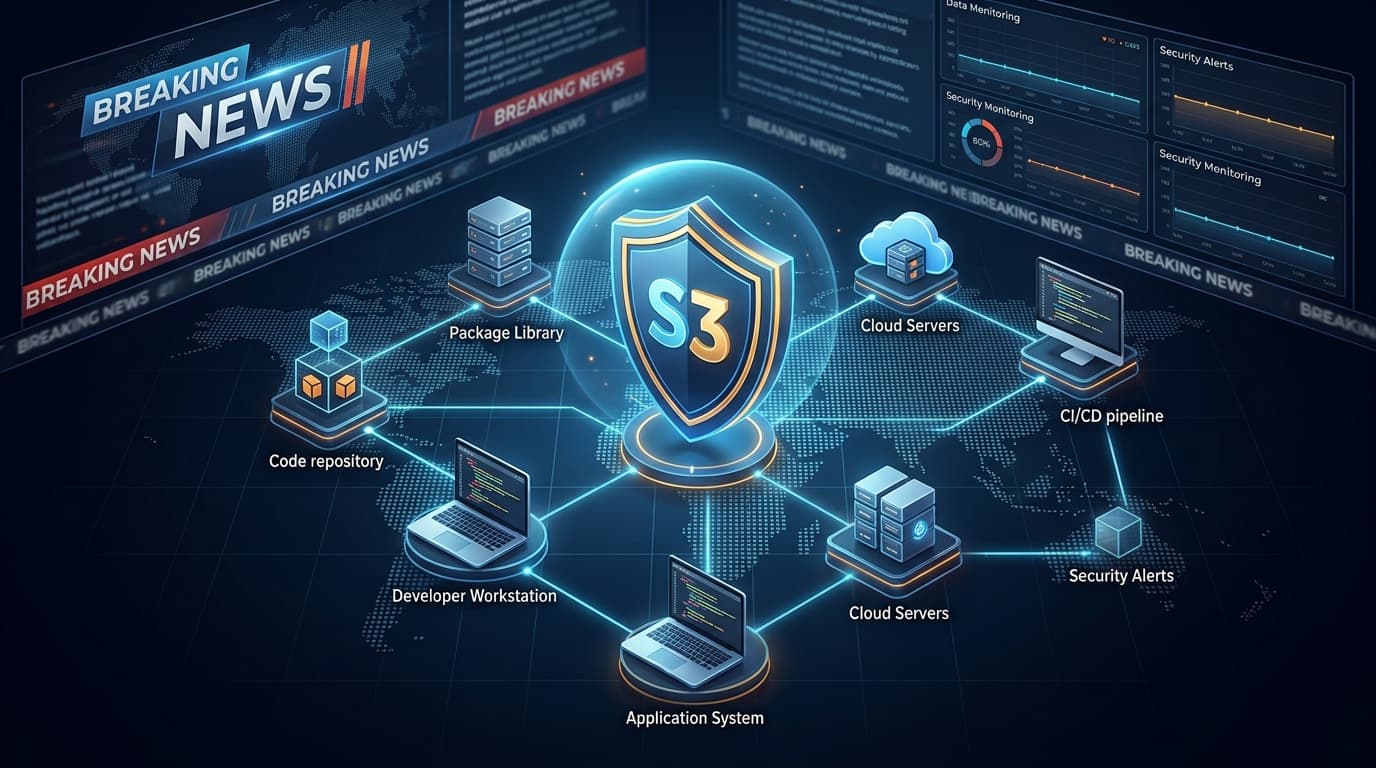
If you’ve searched for software supply chain security news today, you’re not alone. Barely a month goes by in 2026 without another npm package getting hijacked, another maintainer account compromised, or another self-propagating worm spreading through open-source registries before most teams even notice. This isn’t a niche IT concern anymore. Software supply chain security has become a boardroom issue.
Software supply chain security refers to protecting every piece of code, dependency, build pipeline, and human or automated actor involved in creating and shipping software. When any one of those links is compromised, the damage rarely stays contained. It rides downstream into every application that trusted the broken link, which is exactly why software supply chain security has become such an active beat for security journalists and researchers alike.
What’s Driving the Current Wave of Attacks

The single biggest storyline in software supply chain security news today is the return, again and again, of self-replicating npm worms loosely descended from the “Shai-Hulud” malware family. Attackers compromise one maintainer’s GitHub account, often through a phishing email or a poisoned developer tool, then use that access to publish a tainted version of a widely trusted package, turning a single stolen login into a full-blown software supply chain security incident.
Earlier this year, a compromised Visual Studio Code extension gave attackers a foothold that eventually touched dozens of packages tied to major open-source projects, spreading to enterprise repositories through stolen credentials. A separate incident saw a namespace tied to a major cloud vendor compromised after an employee’s GitHub account was hijacked, with malicious code slipped past code review through orphan commits.
Most recently, a widely used key-value storage library with well over a hundred million weekly downloads was hit after its maintainer’s account was taken over. The injected payload quietly added itself to developer tooling configuration files so it would run automatically the next time someone opened the project, no manual install required. It even disguised its commits to look like routine housekeeping changes.
Why These Software Supply Chain Attacks Keep Working
A few patterns show up in nearly every recent software supply chain security incident. Attackers target trusted maintainers rather than end users, because compromising one popular package can silently reach millions of downstream projects. They abuse legitimate developer tools, extensions, and CI/CD credentials rather than writing exploits from scratch. And they increasingly use decentralized infrastructure, including blockchain-based lookups, to rotate command-and-control servers so defenders can’t simply block one domain and call it solved.
There’s also a sobering wrinkle worth understanding: a compromised package can still carry a valid cryptographic signature and pass automated provenance checks. The certificate is real, the build pipeline that produced it is legitimate, and the package is still malicious. That single fact is reshaping how security teams approach software supply chain security and trust in the open-source ecosystem generally.
What the Industry Is Doing About Software Supply Chain Security
Registry operators and platform vendors aren’t sitting still. GitHub has rolled out a default cooldown period on automated dependency update pull requests, holding new releases for a short window before they’re pulled into downstream projects, giving the community time to flag anything suspicious. Self-service credential revocation tools now let developers cut off compromised tokens the moment an incident is discovered rather than waiting on a support ticket.
On the regulatory side, the EU Cyber Resilience Act introduces binding cybersecurity obligations for companies selling software into the European market, with an early compliance deadline landing this September. Organizations that once treated software bill of materials documentation as a static compliance artifact are now being pushed toward continuous, queryable records of exactly what’s running where, so a newly disclosed vulnerability or malicious package can be traced across an entire software fleet in minutes rather than weeks, a shift that is quickly becoming standard practice in modern software supply chain security programs.
Security researchers are also warning that AI-assisted development is accelerating both sides of the software supply chain security fight. Malicious package activity aimed at developer ecosystems has surged dramatically over the past year, and researchers have flagged hundreds of tainted machine learning models sitting in public registries alongside compromised code packages.
Practical Software Supply Chain Security Takeaways for Development Teams

None of this means abandoning open-source software, which remains the backbone of nearly every modern application. It does mean treating software supply chain security as an ongoing discipline rather than a one-time checklist:
- Pin dependency versions and avoid auto-updating to the newest release the moment it ships.
- Use short-lived credentials in build pipelines instead of long-lived static keys.
- Monitor for unexpected changes to developer tooling configuration files, not just source code.
- Maintain an accurate, continuously updated software bill of materials.
- Treat maintainer account security, including multi-factor authentication, as a first-class supply chain control.
One overlooked piece of software supply chain security hygiene is renewal management. Expired code-signing certificates, lapsed vulnerability scanning subscriptions, and forgotten license renewals for security tooling create exactly the kind of silent gap attackers rely on. A dedicated renewal tracker such as Renew Reminder helps security and IT teams keep certificates, software licenses, and vendor subscriptions from quietly lapsing, which is a small but genuinely useful layer of defense within any broader software supply chain security strategy, alongside patching and dependency scanning. It’s available for Android and iOS, so renewal deadlines stay visible no matter which device your team checks first.
Frequently Asked Questions
What is software supply chain security in simple terms? Software supply chain security is the practice of protecting every dependency, build tool, and person involved in creating software, so that a compromise anywhere upstream doesn’t quietly spread into the finished product.
Why is software supply chain security news today mostly about npm? Open-source JavaScript registries host an enormous number of interdependent packages downloaded billions of times weekly, which makes a single compromised maintainer account an unusually efficient way for attackers to reach many organizations at once.
Can a compromised package really pass a software supply chain security check? Yes. Recent incidents have shown that a malicious package can still carry a technically valid signature and pass provenance verification, which is why behavioral monitoring matters as much as signature checks.
What is a software bill of materials, and why does it matter now? A software bill of materials, or SBOM, is an inventory of every component inside an application. In 2026, regulators and security teams increasingly expect it to be a living, searchable record rather than a static document generated once at release time.
How can smaller teams protect themselves without a full security department? Start with the basics: enable multi-factor authentication on every developer and package registry account, pin dependency versions, avoid installing unfamiliar developer tools without review, and keep security-related subscriptions and certificates from expiring unnoticed. These small habits are often what separates strong software supply chain security from weak software supply chain security in practice.
Is software supply chain security only relevant to large enterprises? No. Small teams rely on the same open-source packages as large enterprises, which means software supply chain security matters just as much for a five-person startup as it does for a Fortune 500 engineering org.
The Bottom Line
Software supply chain security news today tells a consistent story: attackers are patient, they target trust rather than technology alone, and the defenses that actually work are the boring, disciplined ones. Rotating credentials, watching for tooling changes, and keeping every certificate and subscription current won’t make headlines, but they’re exactly what separates organizations that ride out the next incident from the ones that become the next case study.